






Disconnected systems create disconnected ministry.
When church data is spread across different platforms, teams lose visibility into the people they’re trying to serve.
Giving data lives in one system. Attendance and groups live in another. Staff members spend hours combining reports manually. Pastors wait too long for information they should already have.
As churches grow, the problem grows with them.
Teams lose confidence in the data. Reporting becomes inconsistent. Automation breaks. Follow-up gets harder. What should help the church move faster starts slowing it down instead.
Many churches have learned the hard way that not every integration is built to last.
Some solutions break when platforms update. Others create duplicate records or incomplete syncs. Instead of simplifying operations, they create even more work behind the scenes.
V1 Church was facing this exact challenge.
As a growing multi-campus church, V1 relied on Planning Center for church operations and Overflow for giving, while HubSpot was meant to become the central hub for reporting, workflows, and communication.
But without a dependable integration, their systems stayed disconnected and difficult to manage.
After earlier integration efforts failed to create a stable long-term solution, V1 partnered with media junction to build a custom integration designed specifically for the needs of modern churches.
The result was a custom solution that syncs Planning Center and Overflow data into HubSpot every hour, helping V1 centralize ministry data, reduce manual reporting work, and create a clearer view across campuses.
the challenge: V1 had the right tools, but not the right connection
V1 Church started in 2016 in a movie theater in Long Island, New York. Since then, the church has grown to six physical locations, including Indiana, Miami, New Jersey, Brooklyn, Manhattan, and Long Island. They also have a large online presence, supported in part by their lead pastor’s strong YouTube following.
As V1 grew, so did the need for better systems.
Planning Center was already a key part of their operations. It helped manage people, registrations, groups, attendance, campuses, ministries, and other church data.
Overflow supported giving.
HubSpot had been added to support marketing, workflows, reporting, and future growth.
Each platform had an important job. But together, they were not giving V1 the full picture.
The team needed to understand things like:
-
Who is attending?
-
Who is giving?
-
Who is part of a group?
-
Who is serving?
-
Who may need follow-up?
-
What is happening at each campus?
Without a dependable sync, getting those answers took too much manual effort.
V1 had tried to solve the issue before. One integration worked for a while, then broke when one of the platforms updated. Another provider helped set up HubSpot properties, but could not create the reliable data flow V1 needed.
That left the team with a familiar problem: HubSpot had potential, but it couldn't become the source of truth until the data was trustworthy.
Why this mattered to V1
For V1, this was not just about cleaning up reports.
It was about helping pastors and campus leaders make better decisions faster.
V1 uses a framework called GATES to track key areas of ministry health:
-
Giving
-
Attendance
-
Teams
-
Engagement
-
Spending
These categories help leaders understand what is happening across campuses. They can see where people are connecting, where follow-up may be needed, and where a campus may need more support.
Ryan Hayward, Director of Operations at V1 Church, explained it this way: “What can’t be managed can’t be scaled.”
That idea shaped the entire project.
When data is split between systems, it becomes harder to see what is really happening. A campus pastor may want to know if giving has dropped in the last 30 days. Another leader may want to see whether small group attendance is growing. Someone else may need to know if a first-time giver has been thanked or if a long-time attendee has stopped showing up.
Those are not just data questions. They are people questions.
When the information is hard to find, teams are slower to respond. When the data is incomplete, leaders have to guess. And when reporting takes too much time, staff spend less time doing the work that only people can do: caring, connecting, and leading.
V1 wanted to change that.
The work: building a bridge between Planning Center, Overflow, and HubSpot
This integration was not a basic sync.
media junction needed to connect two different data sources, Planning Center and Overflow, and bring that information into HubSpot in a way that was useful, clean, and dependable.
That meant more than moving data from one place to another.
The integration needed to handle:
-
Contacts from multiple systems
-
Donations from Overflow
-
Check-ins and attendance from Planning Center
-
Group involvement
-
Associations between records inside HubSpot
-
Duplicate contacts across systems
-
Incomplete or incorrect source data
-
Large syncs with a high volume of records
-
Errors that could not be allowed to stop the full sync
In plain English, the integration had to act like a smart middle layer.
It pulls the data from Planning Center and Overflow. Then it checks the data, organizes it, handles known issues, and brings the right information into HubSpot.
That middle layer matters because source systems are not always clean. Sometimes a contact has a typo in their email address. Sometimes the same person exists in more than one system. Sometimes a record is missing a field HubSpot needs.
Without the right checks in place, those small issues can create bigger problems.
They can break syncs. They can create duplicates. They can make reports unreliable.
So media junction built the integration to validate data before sending it into HubSpot. When the integration finds an issue it can safely clean up, it does. When it finds an issue that cannot be fixed without risking data quality, it logs the issue and keeps the rest of the sync moving.
That way, one bad record does not stop thousands of good records from updating.
keeping the sync stable
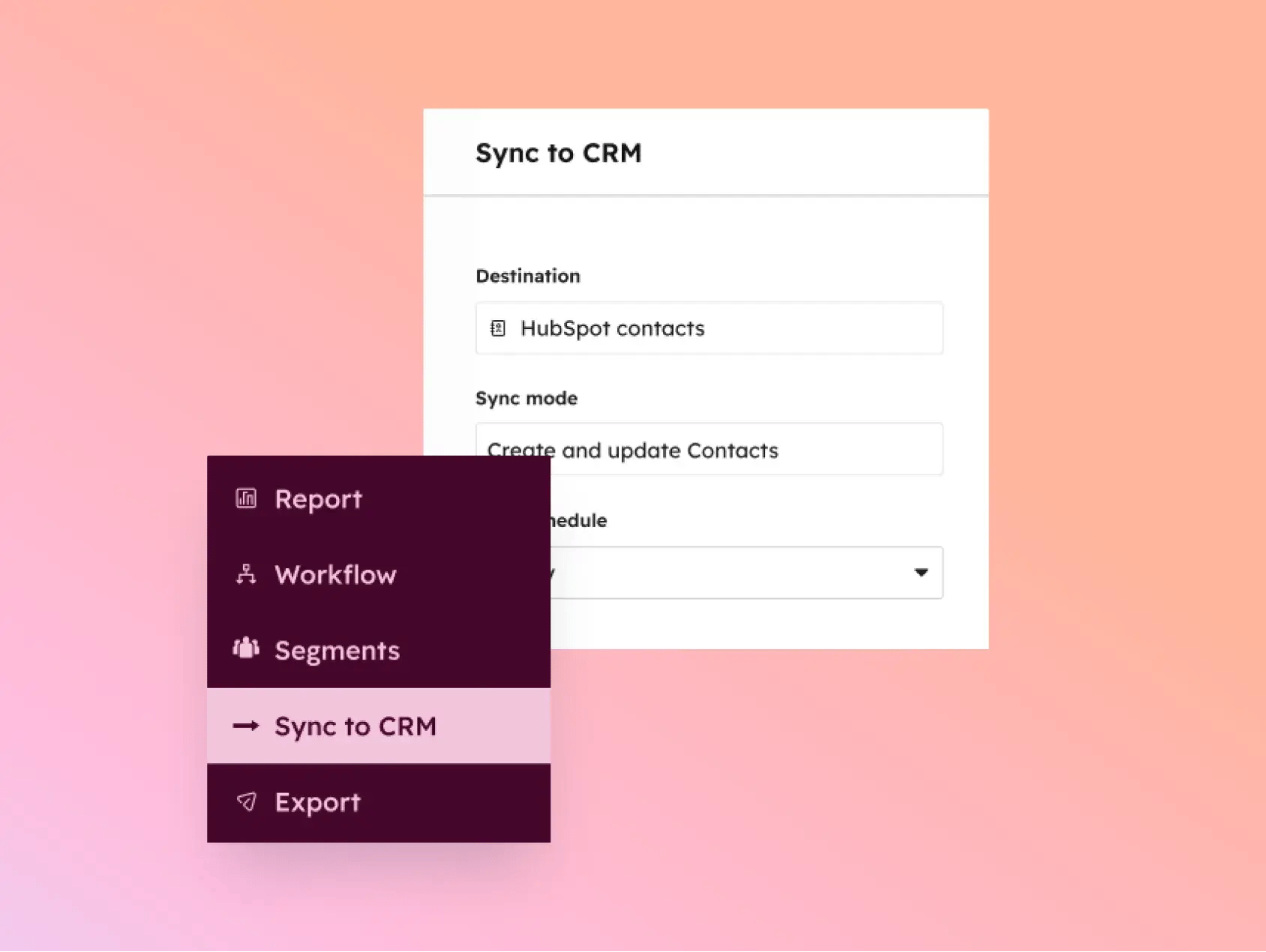
One important decision was making this a one-way sync.
Data flows from Planning Center and Overflow into HubSpot, but not back the other way.
This helps protect the original systems while still giving V1 the reporting and workflow power of HubSpot. Planning Center and Overflow can stay focused on their core jobs, while HubSpot becomes the place where the data comes together.
The integration is also built to run hourly.
That gives V1 more current information without requiring staff to pull reports by hand. Instead of waiting on a manual export or wondering whether a spreadsheet is up to date, leaders can work from dashboards that are refreshed throughout the day.
The integration also includes logging. If an error happens, it is recorded with details so the team can review what happened. This makes the system easier to monitor and maintain.
It is not glamorous work, but it is important work.
A good integration should not only work on launch day. It should keep working when data gets messy, systems change, and the organization grows.
what now lives in HubSpot
With the integration in place, HubSpot can now bring together several important types of data for V1.
-
Contacts help V1 understand the people connected to the church.
-
Deals help track donations.
-
Check-ins help show attendance and participation.
-
Groups help show where people are involved and connected.
These records can also be associated with each other in HubSpot. That means the team can start to see a more complete view of a person’s involvement.
Instead of looking in one system for giving, another for attendance, and another for group involvement, staff can begin using HubSpot as a central place to understand engagement.
That is a big shift.
It makes reporting easier. It gives workflows better data to work from. And it helps pastors and leaders see patterns that would be harder to find across separate tools.
what this makes possible for V1
The most immediate benefit is visibility.
V1 can now build HubSpot dashboards around the information campus pastors need most. Instead of combining separate reports from Planning Center and Overflow, the data is already moving into HubSpot.
That means leaders can begin looking at giving, attendance, groups, and engagement in one place.
Ryan Hayward described the goal simply: pastors should not have to “search multiple platforms” to understand what is happening at their campuses.
With connected data inside HubSpot, they can spend less time hunting for information and more time acting on it.
For example, a campus pastor could see that weekly attendance is strong, but group participation is low. Another campus may have strong giving but declining volunteer engagement. Another may see a drop in men’s groups and need to understand what changed.
These insights help leaders ask better questions.
They also help teams act faster.
V1 can use the data to support follow-up moments, such as:
-
Thanking first-time givers
-
Reaching out to lapsed donors
-
Checking in with people who have stopped attending
-
Supporting group leaders
-
Encouraging people to join teams
-
Identifying campuses that may need more resources
Ryan also emphasized that the purpose of better reporting was not just operational efficiency. The goal was to create “better decision-making and touch points” for the people connected to the church.
That mindset shaped the entire project.
The goal is not to make ministry feel automated or impersonal.
It is the opposite.
When staff have better data, they can make outreach more personal and timely. They can see where people are engaging and where they may be drifting. They can respond with care instead of waiting until someone falls through the cracks.
less manual work, better ministry decisions
Before the integration, V1’s team had to work harder to get a clear view of what was happening.
That often meant pulling reports from different systems, comparing data, checking for overlap, and trying to make sense of it all manually.
Manual reporting can work for a while. But as a church grows, it becomes harder to keep up.
The more campuses, groups, donors, volunteers, and attendees you have, the more difficult it becomes to manage that information by hand.
At some point, manual work becomes a bottleneck.
It slows down reporting. It limits visibility. It creates room for errors. It also takes time away from higher-value work.
By bringing Planning Center and Overflow data into HubSpot, V1 can reduce that manual lift and create a clearer path for decision-making.
Now, instead of spending time building reports from scratch, teams can spend more time reading the data, asking what it means, and deciding what to do next.
That is where the real value is.
why HubSpot matters in the church tech stack
Planning Center is built for church operations. Overflow is built for giving. HubSpot is built for customer relationship management, communication, workflows, and reporting.
For V1, the opportunity was not to replace one system with another.
The opportunity was to let each system do what it does best, then bring the right data into HubSpot so the team could use it more strategically.
That is what makes this kind of integration so valuable.
HubSpot gives churches a powerful place to build dashboards, trigger workflows, manage communication, and view engagement over time. But HubSpot is only as useful as the data inside it.
If the data is incomplete, outdated, or disconnected, the platform cannot deliver its full value.
By connecting Planning Center and Overflow to HubSpot, V1 can use HubSpot in a more meaningful way.
It becomes more than a marketing tool.
It becomes a central place for insight, follow-up, and action.
why this matters for other churches
V1 is not the only church facing this challenge.
Many churches are using several strong tools that do not work together as well as they should. Their teams are doing the best they can with exports, spreadsheets, manual updates, and disconnected reports.
That may be manageable at one campus or with a smaller team.
But as a church grows, the cracks get harder to ignore.
Leaders need better visibility. Staff need cleaner systems. Pastors need information they can trust. And people need to be cared for in a way that feels personal, not scattered.
A reliable integration can help make that possible.
Ryan Hayward encouraged other churches not to give up on solving disconnected systems, even when the process feels difficult. His advice was simple: “Your congregants are worth the effort.”
That perspective reflects the bigger reason projects like this matter.
The goal is not just cleaner data or better dashboards. It is helping churches create better experiences, stronger communication, and more meaningful follow-up for the people they serve.
This project also gave media junction a stronger foundation for helping other churches solve similar problems. While every church has its own systems, data structure, and ministry goals, the V1 integration helped create a more repeatable path for connecting church data to HubSpot.
That does not mean every project is copy and paste.
Church data is personal, complex, and often messy. The right solution still needs thoughtful planning, careful mapping, and a clear understanding of how the church actually operates.
But V1 proved something important: churches do not have to settle for disconnected systems.
As Ryan put it, churches should focus on “measuring outcomes and effect rather than just activity and effort.”
With the right strategy and technical partner, HubSpot and church management tools can work together in a way that supports both operational clarity and real human connection.
A clearer path for ministry growth
The integration is live, and V1’s data is now flowing into HubSpot every hour.
The next step is using that data to build stronger dashboards, improve workflows, and help campus pastors make better decisions.
Over time, V1 will be able to measure how this connected data affects reporting, follow-up, engagement, and ministry outcomes.
For now, the foundation is in place.
V1 no longer has to rely on disconnected reports to understand what is happening across campuses. Their team can begin using HubSpot as a clearer source of truth for giving, attendance, groups, and engagement.
That is a major step forward.
Because better data is not really about software.
It is about helping leaders see people more clearly.
It is about giving staff more time to focus on ministry instead of manual reporting.
And it is about building systems that can grow with the church, instead of holding it back.